



Core Data Model
A hypercert is an activity claim with linked records that describe work done. The activity claim is the anchor — contributions, attachments, measurements, and evaluations reference it to add context.
This page explains what records exist, what they contain, and how they connect.
The core record: activity claim#
Every hypercert starts with an activity claim — the central record that answers four questions:
| Dimension | Question | Example |
|---|---|---|
| Contributors | Who is doing (or did) the work? | Alice, Bob |
| Work scope | What are they doing (or what did they do)? | Documentation, Reforestation |
| Time of work | When is it happening (or when did it happen)? | January – March 2026 |
| Location | Where is it taking (or did it take) place? | Coastal Kenya |
The activity claim gets a permanent AT-URI like at://did:plc:alice123/org.hypercerts.claim.activity/3k7.
Additional details#
The activity claim has a contributors array. Each entry is a contributor object with three fields:
contributorIdentity— either an inline identity object (#contributorIdentity, containing anidentityDID string) or a strong reference to anorg.hypercerts.claim.contributorInformationrecord with a full social profilecontributionWeight— an optional relative weight string (e.g."1","0.5")contributionDetails— either an inline role object (#contributorRole, containing arolestring) or a strong reference to anorg.hypercerts.claim.contributionrecord with structured contribution data
Simple cases use inline objects directly in the activity claim. Richer profiles use separate records that the contributor or project lead creates independently.
| Record type | What it adds | Who creates it | Lexicon |
|---|---|---|---|
| Contributor Information | Social profile, image, display name | The contributor or project lead | org.hypercerts.claim.contributorInformation |
| Contribution | Structured role and contribution data | The contributor or project lead | org.hypercerts.claim.contribution |
Records that attach to a hypercert#
Other records link to the activity claim to add context. Again, each is a separate record with its own AT-URI – they reference the activity claim, not the other way around.
The following diagram shows record types and how they reference the activity claim. Records can be created by different people and live in different repositories.
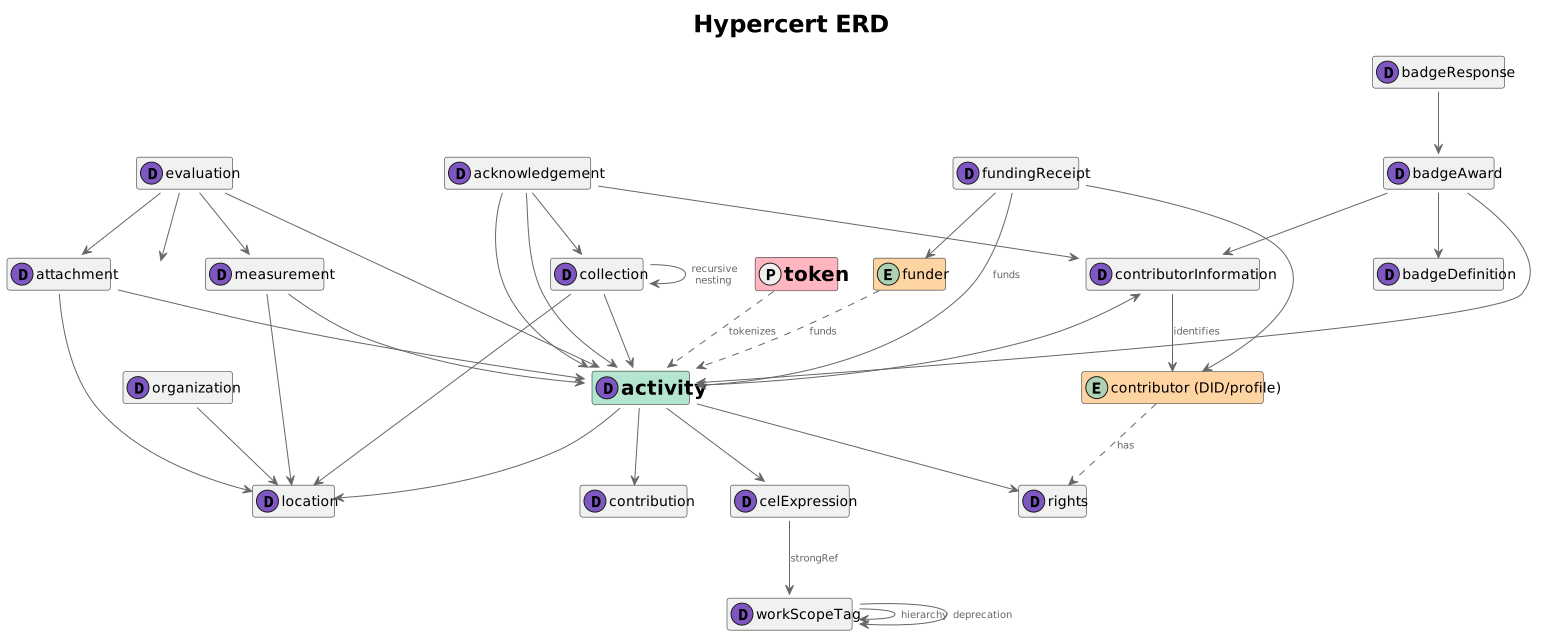
The diagram includes a token entity — tokenization (anchoring a hypercert on-chain) is not yet implemented.
| Record type | What it adds | Who creates it | Lexicon |
|---|---|---|---|
| Attachment | Supporting documentation — URLs, uploaded files, IPFS links. Can link to any record type, not only activity claims. | Anyone with additional data | org.hypercerts.context.attachment |
| Measurement | Quantitative data — "12 pages written", "50 tons CO₂ reduced" | E.g. a third-party measurer or the project (self-reported) | org.hypercerts.context.measurement |
| Evaluation | An (independent) assessment of the work | E.g. a third-party evaluator, community members, beneficiaries | org.hypercerts.context.evaluation |
Additional notes#
- Records don't have to be created together. Users can create a measurement first and link it to an activity claim later.
- A record can also be linked to multiple other records, e.g. a measurement in a bioregion is linked to multiple activity claims.
- An evaluator creates an evaluation from their own account — it references an activity claim but lives in their personal data server.
This means a hypercert grows over time – it is a living record. The core claim stays the same, but attachments, measurements, and evaluations accumulate around it.
Grouping hypercerts#
Hypercerts can be grouped into collections. A multi-year project might have one hypercert per year, with a collection representing the full project. But collections are flexible — anyone can create one for any purpose. Someone might curate a personal collection of hypercerts they find interesting, or an organization might group all their hypercerts together. A hypercert can belong to many collections.
| Record type | What it adds | Who creates it | Lexicon |
|---|---|---|---|
| Collection | Groups activity claims and/or other collections into a project or portfolio. Supports recursive nesting. | E.g. the project organizer | org.hypercerts.collection |
How records connect#
Records reference each other using strong references — if a referenced record is modified after the reference was created, the change is detectable.
Activity Claim (the core record)
├── contributors[0]
│   ├── contributorIdentity: {identity: "did:plc:alice..."} (inline #contributorIdentity or ref to ContributorInformation)
│   ├── contributionWeight: "1"
│   └── contributionDetails: {role: "Lead author"} (inline #contributorRole or ref to Contribution)
├── contributors[1]
│   ├── contributorIdentity: → ContributorInformation record (Bob)
│   └── contributionDetails: → Contribution record (Technical reviewer, Jan-Mar)
├── Attachment: GitHub repository link
├── Measurement: 12 pages written
├── Measurement: 8,500 words
└── Evaluation: "High-quality documentation" (by Carol)
Mutability#
Activity claims and their linked records are currently immutable once created. Record versioning and edit history will be supported in a future release, along with the ability to lock a hypercert at a specific version for funding.
What happens next#
Once you understand the data model, you're ready to build:
- Quickstart — create your first activity claim
- Quickstart — build a complete hypercert with all record types
- Lexicon reference — field-by-field schema for every record type
Next: Certified Identity — who authors records and how signatures work.